Batch Content Creation for Instagram Ads: Record a Week in One Day, Edit With AI
One recording day a week, scripts written in advance, a phone instead of a studio and AI editing that learns your style: a week of Instagram ads, no editor.
 Maciej RakCEO and co-founder
- 9 min read
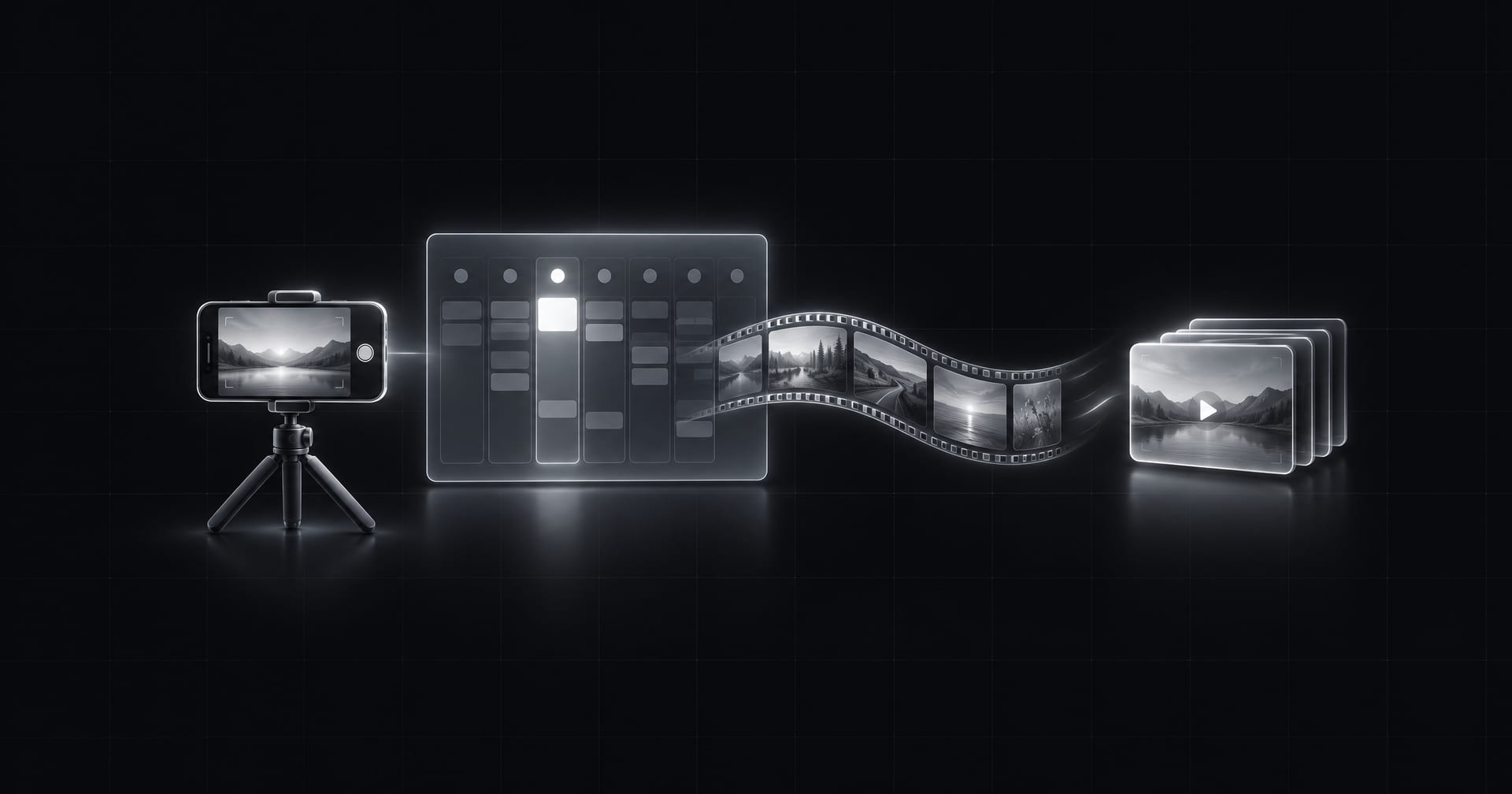
Batch content creation means producing a whole week of ads in one sitting instead of filming a little every day. For a high-ticket business running Instagram ads, the routine I see work best is simple: one recording day a week, scripts ready before it starts, a phone instead of a studio, and editing handed to AI that has learned your style. Done this way, production stops being a weekly fight and becomes a block in the calendar.
Below is the process I see among our clients who scale high-ticket offers on Instagram. It is a set of practices, not a promise of results. I walk through each step in the video above.
Plan one recording day a week
Choose one day a week for production. Saturday works for many people. More important than the day is your energy: pick a day when you are rested, because production often takes longer than planned. Something you expect to finish in 30 or 40 minutes can take two hours, especially at the start.
Production starts before recording day. By the time you sit down to film, every ad should already be written, rehearsed and pasted into the teleprompter app on your phone. The recording morning is not the time to write scripts. All your attention goes into delivery.
If you don’t know what to say in those ads yet, start with the content strategy for high-ticket offers and the follower ad templates, then come back here for the production side.
Protect your energy on the day
A client asked me at one of our mastermind calls how to keep energy and motivation high in business. It sounds like a soft question, but it decides how well you deal with everything, including filming ads. Recording when you feel eight out of ten is far easier than at six.
The common advice is to get up, grab a coffee and sit down at the computer. That never worked for me: two or three hours later I felt drained. What changed the most for me was starting the day with 45 minutes of easy cardio. Your version can be different. The point is a morning ritual that puts you in a good state before anything else reaches you.
That means no email and no social media before you record. No angry client, refund request or rejected Facebook ad should get into your head that morning. Good energy, focus and airplane mode: that is your recording space.
A phone beats a studio
You don’t need professional equipment. A phone is enough, and UGC-style ads shot on a phone very often perform better than ads from a podcast studio where everything is perfect and polished. As a rule, the more your ad looks like native content on the platform, the better.
Think about your mailbox. If it’s full of flyers, you probably carry them straight to the bin without reading. But if there’s a white envelope with your name handwritten on it, you open it, because it doesn’t look like advertising. Ads work the same way: in most cases, the less an ad looks like an ad, the better it works as one.
How to talk to the camera
A few habits make delivery easier:
- Speak at about 130% of your normal volume. Not shouting, just around 30% more energy than in a normal conversation, while staying natural.
- Don’t treat the viewer as stupid. Don’t put on a different persona when the camera starts. People notice.
- Treat the teleprompter as a hint. If you say something differently from the script, the way you would naturally say it, even better.
- Don’t chase the perfect take. People pick up far more from how you feel than from the exact words. If you’re tense, the viewer feels it too. A slip of the tongue is fine; a stiff delivery isn’t.
If recording feels like hard labour, with a tight throat and a dozen restarts per sentence, something is off. It should feel like talking to one person.
Record 15 bad takes first
My favourite trick: before the real takes, record 15 practice ads with the goal of messing them up. Take the phone, walk around the flat and talk to the camera. Don’t stop to correct yourself, just keep going.
Paradoxically, when you’re trying to make mistakes, you make far fewer. After a few rounds you’ll notice you’re speaking fluently and naturally. The real ads come out better, and you don’t wear yourself out, which matters because you’ll be doing this every week.
How many ads to record
If you spend a few hundred zloty a day on ads (very roughly $100 to $250), recording at least three new ads once a week is usually the right rhythm. New creative keeps the account fresh and gives you something to test. The follower ads built from your clients’ own words piece explains how to choose what goes into each one.
Edit with AI, and teach it your style
Here is the part that changed the most in the last year. An AI editor won’t complain when it hears the same sentence for the fifteenth time. You can record one long, imperfect take, hand it to AI and get an edited ad back quickly. That closes the whole production in one day.
On our side we use Claude Code for this. Despite the name, it isn’t only a coding tool: it can work with files on your computer and follow written procedures. On one subscription we edit dozens of Reels a week plus two YouTube videos, with room to spare. By my rough estimate, that is about 25 times cheaper than the editing it replaced, around 200 euros a month instead of around 5,000.
Is it really just “drop the video in and get a finished Reel”? Yes and no. Most people expect perfect output on the first try and give up after an hour. What works is spending a few hours once to build your editing style:
- Install an editing procedure. In Claude Code this is called a skill: a written procedure, for example “how to edit a Reel”. You can download a ready one and ask Claude to install it.
- Run five to seven feedback rounds. Let it edit, watch the result, then record a voice note: “At second 10 I don’t like this, do it this way instead.”
- Give it visual references. Your carousels, brand colours, or examples of a style you like, for instance from Pinterest. If an animation mentions your ebook, give it your ebook cover.
- Tell it to learn. Say once: “Every time I give you feedback, save it permanently into the skill, so I never have to repeat it.” That’s what turns a few hours of corrections into an editor that keeps your style.
After a few weeks you can have finished Reels the same day you record them, and even several variants of one Reel with different music or animations, so you can test which version works before you publish it on your main profile.
Use AI the “idiot way”
Many people think using AI for work like this needs special skills, forums and technical knowledge. It doesn’t. To get good at AI, use it like an idiot: ask the obvious questions and don’t expect yourself to know anything up front.
Don’t know what a skill is? Ask: “Hey, how does this work? What do I need to install?” Want it to edit YouTube videos too? Ask. Want it to add music? Ask. Every question that comes to mind goes to the AI. Using AI to learn AI is, in my view, the most important habit for getting better at it.
Optional: a B-roll library
If you want cutaway shots in your ads, build a library once:
- Shoot short clips on your phone during the week.
- Once a week, upload them to a shared folder.
- Give the AI the folder and ask it to watch every clip and rename it with a description of what’s on screen.
- Correct it where needed, for example: “The man making breakfast is me.”
Now, when an ad talks about preparing meals, the AI can look through the library, pick the best of three matching clips and cut it in. You never have to search through 50 or 100 clips by hand. It’s optional, but it makes ads look far less like a talking head.
Where the ads lead
Production is only half of it. Every ad you ship should bring people into a conversation, and that conversation needs to start the moment someone follows or messages you, at any hour. Setor runs that part: it greets new followers, qualifies them in DMs and books calls, and the Instagram CRM shows which content the booked calls actually came from. That tells you which of this week’s ads deserves next week’s budget.
FAQ
What is batch content creation? Producing a batch of content, for example a week of ads, in one session instead of filming every day. It saves set-up time and keeps your energy for delivery.
How many Instagram ads should I record each week? If you spend a few hundred zloty (very roughly $100 to $250) a day on ads, at least three new ones a week is a good rhythm. More budget usually needs more fresh creative.
Can AI really edit Instagram Reels? Yes, and well, once you’ve spent a few hours teaching it your style through feedback rounds. Expect the first edits to need corrections.
Do I need a studio or a professional camera for ads? No. A phone and a teleprompter app are enough. Phone-shot ads that look like organic content often perform better than studio productions.
Where the numbers come from
- The 130% volume tip, 15 practice takes, three ads a week, five to seven feedback rounds and the cost comparison: my own practice and rough estimates from working with high-ticket businesses, not a study.
- No Setor database figures are used in this article.
Want every ad to land in a conversation that’s answered right away? Start now and see how Setor would run your DMs. For what to say in those ads, read the follower ad templates next.